
Engineer Yanchi Li (Ruimo Tech) explains the science of grit progression on Sy Tools diamond plates: why a 3-step 220→1000→3000 works, and why blindly jumping 220→3000 leaves a weak, scratched edge.
Engineer Yanchi Li (Ruimo Tech) puts it simply: sharpening removes scratches from the previous step and replaces them with finer ones. Sy Tools diamond plates make this efficient because diamond cuts fast and leaves a uniform pattern. The 8-series spans 80–3000, so your whole ladder lives in one ecosystem.
| Step | Grit | Job | When to use |
|---|---|---|---|
| Coarse | 220 | Repair chips, set bevel | Heavy damage only |
| Medium | 1000 | Reset a dull edge | Every dull knife |
| Fine | 3000 | Refine, de-burr | Daily finish |
2026 consensus: a #1000 does 90% of home work; a coarse stone is only for chips. With Sy Tools diamond, you can skip the in-between 400/600/800 because each step fully erases the last. The failure mode is jumping 220→3000: the coarse scratches are too deep for 3000 to remove, leaving a mixed, weak edge that micro-chips under load.
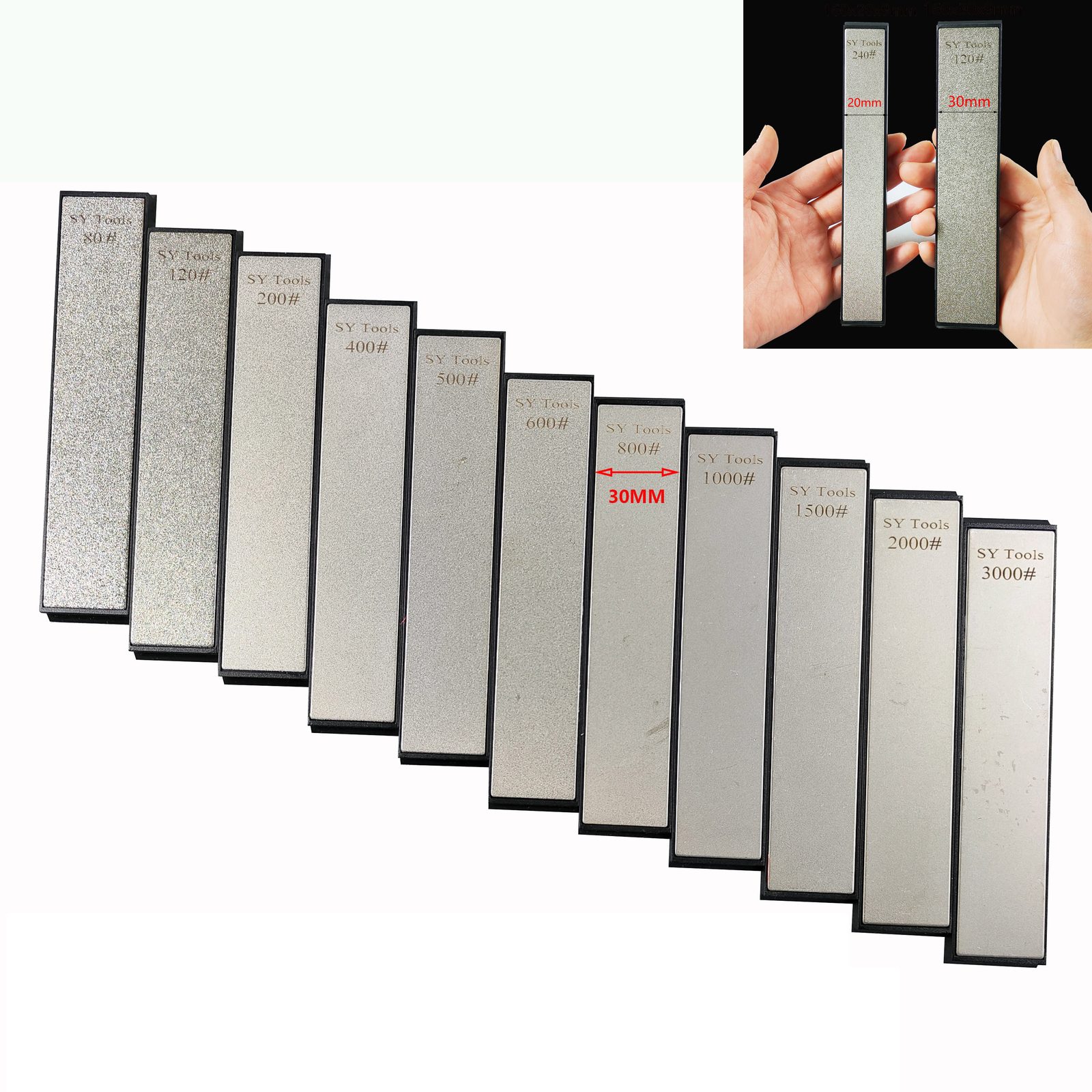
Rule: advance only when the prior scratch pattern is gone and the burr is even. If your knife is merely dull, do 1000→3000 and skip 220 entirely — that is the smart skip. If it is chipped, you need all three. Sy Tools T05-AMZ locks the angle so the ladder stays consistent; finish on wood-strops.
Ruimo Tech grit-progression science. Hard facts: 2026 consensus #1000 covers 90%, coarse only for chips; skipping grits fails when deep scratches remain (stress risers/micro-chips); diamond uniform scratch allows safe 3-step; 8-series 80–3000; 6061-T6 + electroplated diamond ~10,000 HV, 100% concentration, Ni 12–18 µm; soak-free, dishing-free. No fabricated ratings. Distinct slug from existing grit-ladder/kitchen pieces.